What is ovarian cancer?
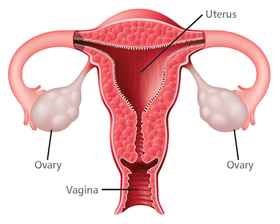
The ovaries are an essential part of the female reproductive system, responsible for hormone production and egg release.
- Location
- Found in the pelvis, one on each side of the uterus.
- Each ovary is approximately the size of an almond.
An egg travels from an ovary through a fallopian tube to the womb (uterus). When a woman goes through her menopause, her ovaries stop releasing eggs, and far lower levels of hormones are produced. The ovaries contain primitive cells, which are cells that go on to become eggs, and epithelial cells. Primitive cells that become cancerous are called germ cell tumours. Epithelial cell cancers of the ovary are more common than germ cell cancer.
Signs & symptoms
Unfortunately, early ovarian cancer often does not cause obvious symptoms. This is why it is often known as a "silent killer". But, as the cancer grows, symptoms may include:
- Pressure or pain in the abdomen, pelvis, back or leg
- A swollen or bloated abdomen caused by a build-up of fluid or a tumour
- Nausea, indigestion, gas, constipation, or diarrhoea
- Trouble eating or feeling full quickly
- Feeling very tired all the time
Less common symptoms include:
- Shortness of breath
- Feeling the need to urinate often
- Unusual vaginal bleeding (heavy periods, or bleeding after menopause)
A doctor should be consulted if the above symptoms occur.
Risk factors
- Strong family history of ovarian, breast, uterus or colorectal cancer
- Personal history of cancer (Women who have had cancer of the breast, uterus, colon, or rectum have a higher risk of ovarian cancer)
- Late pregnancy or women who have never been pregnant
- Early onset of menstruation/ Late menopause
What can you do to prevent ovarian cancer?
Use of Oral Contraceptives
- Taking birth control pills for 5+ years can lower the risk of ovarian cancer by 30–50%.
- Consult a doctor to weigh the benefits against possible side effects.
Pregnancy & Breastfeeding
- Women who have given birth before age 30 have a reduced risk.
- Breastfeeding for at least 12 months further lowers the risk.
Surgical Prevention for High-Risk Women
- Tubal Ligation (Tying the Fallopian Tubes) – May lower risk by 30–50%.
- Salpingo-Oophorectomy (Preventive Removal of Ovaries & Fallopian Tubes) – Reduces risk by 80–90% in women with BRCA1/BRCA2 mutations.
Healthy Lifestyle Choices
- Maintain a Healthy Weight – Obesity is linked to a higher risk of ovarian cancer.
- Regular Physical Activity – Lowers overall cancer risk.
- Avoid Smoking & Limit Alcohol Consumption – May help lower risk.
Genetic Testing & Medical Check-Ups
- Women with a family history of ovarian, breast, or colorectal cancer should consider genetic testing for BRCA mutations.
- Regular pelvic exams and discussions with a doctor can help monitor for early signs.
How is ovarian cancer diagnosed?
If you have a symptom that suggests ovarian cancer, your doctor must find out whether it is due to cancer or to some other causes. Your doctor may ask about your personal and family medical history. You may have one or more of the following tests.
- Physical exam: Your doctor checks general signs of health. Your doctor may press on your abdomen to check for tumours or an abnormal build-up of fluid.
- Pelvic exam: Your doctor feels the ovaries and nearby organs for lumps or other changes in their shape or size.
- Blood tests: Your doctor may order blood tests. The lab may check the level of several substances, including CA-125. CA-125 is a substance found on the surface of ovarian cancer cells and on some normal tissues. A high CA-125 level could be a sign of cancer or other conditions. The CA-125 test is not used alone to diagnose ovarian cancer. This test is approved by the U.S. Food and Drug Administration for monitoring a woman's response to ovarian cancer treatment and for detecting its return after treatment.
- Ultrasound: The ultrasound device uses sound waves that people cannot hear. The device aims sound waves at organs inside the pelvis. The waves bounce off the organs. A computer creates a picture from the echoes. The picture may show an ovarian tumour. For a better view of the ovaries, the device may be inserted into the vagina (transvaginal ultrasound).
- Biopsy: A biopsy is the removal of tissue to look for cancer cells. Based on the results of the blood tests and ultrasound, your doctor may suggest surgery (a laparotomy) to remove tissue and fluid from the pelvis and abdomen. Surgery is usually needed to diagnose ovarian cancer.
- Laparoscopy: The doctor inserts a thin, lighted tube (a laparoscope) through a small incision in the abdomen. Laparoscopy may be used to remove a small, benign cyst or an early ovarian cancer. It may also be used to learn whether cancer has spread.
Importance of early detection in ovarian cancer
EEarly detection of ovarian cancer improves survival rates and allows for less aggressive treatment. Since symptoms are often vague, regular pelvic exams, transvaginal ultrasounds, and CA-125 blood tests help detect abnormalities early. When diagnosed at Stage 1, the survival rate exceeds 90%, highlighting the need for timely screening.
|
Treatment of ovarian cancer
Treatment Options:
For ovarian cancer, most women have surgery and chemotherapy.
Surgery
The surgeon makes a cut in the wall of the abdomen. This type of surgery is called a laparotomy. If ovarian cancer is found, the surgeon removes:
- both ovaries and fallopian tubes (salpingo-oophorectomy)
- the uterus (hysterectomy)
- the omentum (the thin, fatty pad of tissue that covers the intestines)
- nearby lymph nodes
- samples of tissue from the pelvis and abdomen
If the cancer has spread, the surgeon removes as much cancer as possible. This is called "debulking" surgery.
If you have early Stage I ovarian cancer, the extent of surgery may depend on whether you want to get pregnant and have children in future. Some women with very early ovarian cancer may decide with their doctor to have only one ovary, one fallopian tube, and the omentum removed.
Chemotherapy
Chemotherapy uses anticancer drugs to kill cancer cells. Most women have chemotherapy for ovarian cancer after surgery. Some women have chemotherapy before surgery. Chemotherapy is given in cycles. Each treatment period is followed by a rest period. The length of the rest period and the number of cycles depend on the anticancer drugs used. You may have your treatment in a clinic, at the doctor's office, or at home. Some women may need to stay in the hospital during treatment.
Treatment options (by stages):
[Stage 0] Cancer is confined to the surface layer of the ovary and has not invaded deeper tissues or spread beyond the ovary.
- Surgery (Primary Treatment):
- Unilateral Salpingo-Oophorectomy – Removal of the affected ovary and fallopian tube while preserving fertility.
- Bilateral Salpingo-Oophorectomy – Removal of both ovaries and fallopian tubes for higher-risk cases.
- Total Hysterectomy with Bilateral Salpingo-Oophorectomy – Removal of the uterus, both ovaries, and fallopian tubes (common for postmenopausal or high-risk patients).
- Observation & Follow-Up:
- Regular pelvic exams, CA-125 blood tests, and imaging (ultrasound/CT scans) to monitor recurrence.
- No chemotherapy or radiation required unless abnormal cells are detected later.
[Stage 2] Cancer has spread beyond the ovaries to nearby pelvic structures such as the fallopian tubes, uterus, or bladder.
- Surgery (Debulking Surgery):
- Removal of the uterus, both ovaries, fallopian tubes, nearby lymph nodes, and parts of affected tissues.
- Goal: Remove as much cancer as possible.
- Chemotherapy:
- Given before and after surgery to shrink tumours and eliminate residual cancer cells.
[Stage 3] Cancer has spread beyond the pelvis to nearby lymph nodes or the abdominal lining.
- Debulking Surgery:
- Removal of all visible tumours in the pelvis and abdomen.
- May involve removing sections of the intestine, bladder, or diaphragm if cancer has spread.
- Chemotherapy:
- Combination chemotherapy (Platinum-based drugs like Carboplatin and Paclitaxel) is standard.
- Can be given intravenously or directly into the abdomen (intraperitoneal chemotherapy).
- Targeted Therapy (For Selected Patients):
- Bevacizumab (Avastin) – A targeted drug that blocks blood supply to tumours.
- PARP Inhibitors (Olaparib, Niraparib, Rucaparib) – Used in patients with BRCA mutations.
[Stage 4] Cancer has spread to distant organs such as the liver, lungs, or other areas of the body.
- Palliative Surgery (If Applicable):
- Surgery may help relieve blockages or complications but is usually not curative.
- Systemic Chemotherapy:
- Given to control cancer spread and improve quality of life.
- Targeted Therapy & Hormonal Therapy (For Specific Cases):
- PARP Inhibitors for patients with BRCA mutations.
- Hormonal Therapy may be considered in rare cases.
- Palliative Care & Symptom Management:
- Focuses on pain relief and quality of life improvement.
- Supportive treatments such as fluid drainage and nutritional support.
Surgical Options:
1. Unilateral Salpingo-Oophorectomy (USO)
- Removes one ovary and one fallopian tube.
- Used in early-stage ovarian cancer (Stage 1A) when fertility preservation is desired.
2. Bilateral Salpingo-Oophorectomy (BSO)
- Removes both ovaries and both fallopian tubes.
- Used for Stage 1B or higher when cancer affects both ovaries.
3. Total Hysterectomy with Bilateral Salpingo-Oophorectomy (TH/BSO)
- Removes the uterus, cervix, both ovaries, and fallopian tubes.
- Standard surgery for advanced ovarian cancer (Stage 2 and above).
4. Omentectomy
- Removes the omentum (a fatty tissue layer in the abdomen where ovarian cancer often spreads).
- Usually done along with a hysterectomy.
5. Lymph Node Dissection
- Removes pelvic and para-aortic lymph nodes to check for cancer spread.
6. Cytoreductive (Debulking) Surgery
- Removes as much of the tumour as possible in Stage 3 or 4 ovarian cancer.
- May involve removing parts of the intestines, spleen, or bladder if cancer has spread extensively.
7. Interval Debulking Surgery (IDS)
- Performed after neoadjuvant chemotherapy to shrink tumours before surgery.
8. Palliative Surgery
- Bowel Resection: Removes parts of the intestine if cancer causes a blockage.
- Paracentesis: Drains excess abdominal fluid to relieve discomfort.
Post treatment
After ovarian cancer treatment, ongoing care is essential to monitor for recurrence, manage side effects, and improve overall well-being.
Regular Medical Follow-Ups
- Pelvic exams, CA-125 blood tests, and imaging scans every 2-4 months for the first 2 years, then less frequently.
- Report any abnormal bloating, pelvic pain, or unexplained weight loss to your doctor.
Managing Long-Term Side Effects
- Surgical menopause (if ovaries were removed) may require hormone replacement therapy (HRT) to manage symptoms.
- Fatigue and neuropathy from chemotherapy can persist—physical therapy and a balanced diet help recovery.
Emotional & Sexual Health
- Counselling or support groups can help cope with emotional and mental health challenges.
- Vaginal dryness and sexual discomfort can be managed with lubricants or hormonal therapy.
Lifestyle Adjustments to Lower Recurrence Risk
- Maintain a healthy weight, eat an anti-inflammatory diet, and exercise regularly.
- Quit smoking and limit alcohol intake to reduce cancer recurrence risk.